

Short answer: yes, you need both - and they do completely different jobs.
Instagram gets you discovered. Your website is where people decide whether to trust you enough to spend money.
Most small businesses in Malaysia and India start with Instagram or Facebook because it's free, fast, and their customers are already there. That logic is correct. But at some point - usually when growth stalls or enquiries feel unreliable - the same business owners start asking: "Do I actually need a website, or is this just extra cost?"
Here's the honest breakdown.
What Instagram Does Well for Your Business
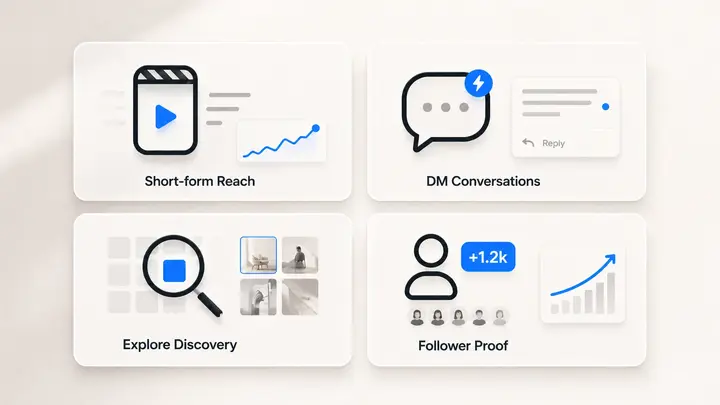
Instagram is a genuine business tool. It handles things a static website cannot:
- Discovery through hashtags, reels, and the Explore page - new people find you without paying for ads
- Visual portfolio - food, fashion, services, and products show better in a scrollable feed than on a webpage
- Two-way conversation - DMs, comments, and stories let you build rapport quickly
- Social proof in public - likes, comments, and follower counts are visible to strangers, which builds early trust
If you're a food business, a tailor, a freelancer, or a local service provider - Instagram is doing real work for you. This article is not arguing against it.
What Instagram Can't Do for Your Business
This is where the gap shows up.
1. You don't own it.
Instagram can suspend your account, change its algorithm, or go offline. It has done all three. A website - hosted on your own domain - is yours. Nobody can take it down except your hosting provider, and you control that relationship.
2. You can't rank on Google.
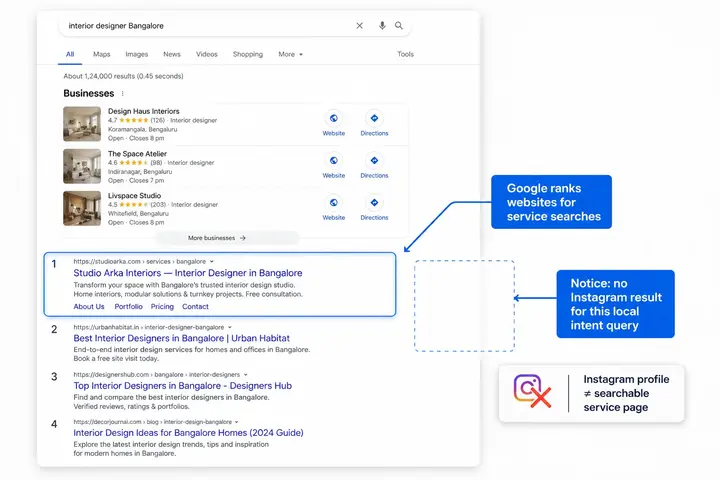
When someone types "best interior designer in Kuala Lumpur" or "affordable catering service Bangalore" into Google, your Instagram profile will almost never appear. A properly built website can. That's called SEO (Search Engine Optimization), and it requires a website to work.
3. It looks less credible to certain buyers.
A buyer comparing three suppliers before spending RM 5,000 or INR 50,000 will Google each one. If two have websites and one only has Instagram, the one without a website loses - not because of the content, but because the absence of a website signals something small or uncertain.
4. You can't take bookings or payments cleanly.
Collecting orders via DM is friction. A website can have a booking form, a checkout page, or a WhatsApp button that routes customers to the right action. The process feels more professional because it is more professional.
5. You lose data when the platform changes.
Instagram doesn't give you your followers' email addresses. If you ever want to run an email campaign, retarget visitors with ads, or contact your audience directly - you can't, unless you've been capturing that data on your own website.
6. Your reach is controlled by the algorithm, not you.
You might have 4,000 followers and reach 300 of them on a given post. A website with basic SEO serves every visitor who searches for what you do, 24 hours a day, without paying per post boost.
Instagram vs. Website: A Side-by-Side Comparison
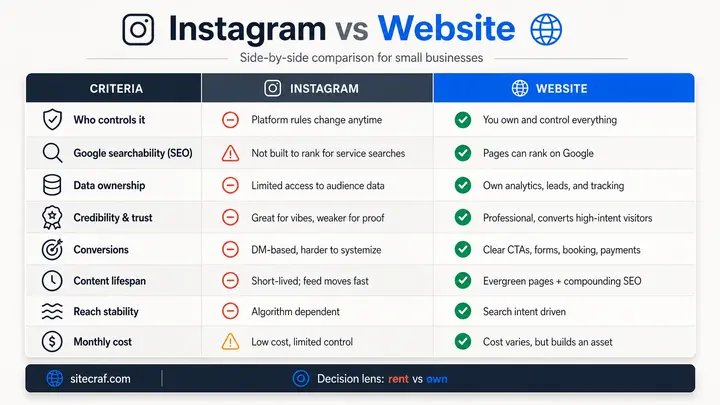
| | Instagram | Website | |---|---|---| | Who controls it | Meta | You | | Google searchability | Almost none | Full, if built correctly | | Customer data ownership | No - Meta owns it | Yes - yours to keep | | Professional credibility | Moderate | High | | Payment / booking capability | Limited | Full | | Content permanence | Algorithm-dependent | Stable | | Monthly cost | Free (organic) | ~RM 50-200/month depending on care plan | | Available 24/7 without effort | Only if you keep posting | Yes |
The Trust Gap: Why Buyers Still Google You Before They Buy
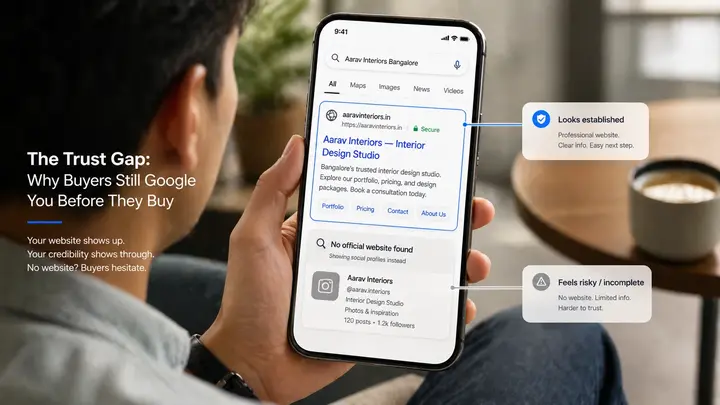
Most buyers - especially for services above a few hundred ringgit or rupees - run a quick Google search before they message you.
They're not looking for more content. They're checking: Is this a real business?
A website signals permanence. It says you've been here long enough to register a domain, pay for hosting, and set up a proper online presence. An Instagram page, however active, doesn't carry the same weight - particularly for B2B sales, professional services, and anything involving a contract or significant spend.
In Malaysia and India, where WhatsApp and Instagram are dominant for day-to-day business, the absence of a website has become more noticeable, not less - because every mid-size competitor has one.
When a One-Page Website Is All You Need to Start
You don't need a 10-page website. You don't need a blog, a members area, or an online store on day one.
A one-page landing site can cover:
- What you do and who it's for
- Why you're the right choice (social proof, past work, credentials)
- How to contact you or book a call
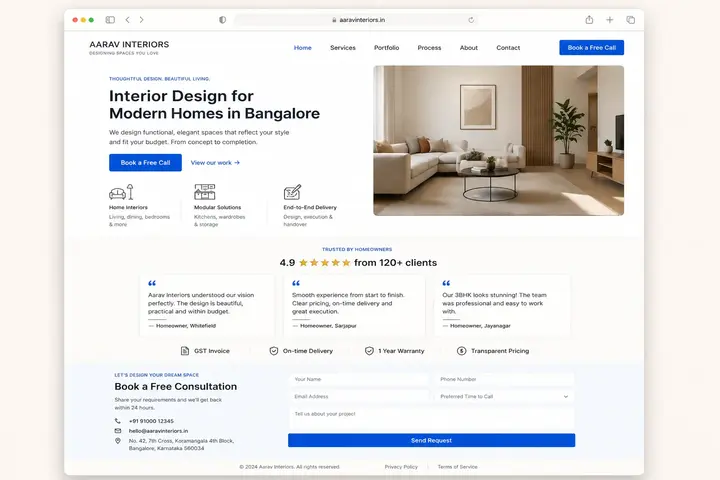
That's it. One page, one domain, properly built. It costs less than most people expect, and it does the specific job that Instagram cannot: it gives Google something to index, gives buyers a credible place to land, and gives you a stable foundation to build on.
Sitecraf builds these for small businesses in Malaysia and India. The process takes one to two weeks and requires minimal input from you.
What Happens When You Have Both
A clothing boutique in Penang posts consistently on Instagram - reels, outfit photos, size guides. They have 8,000 followers and a steady stream of DM enquiries.
They add a simple website: their story, a lookbook, a size chart, and a WhatsApp button. Within a few months, Google starts surfacing them for searches like "boutique clothing Penang" and "plus size fashion Malaysia."
The Instagram audience grows from social. The website audience comes from Google. Two separate channels, two separate audiences, one business benefiting from both.
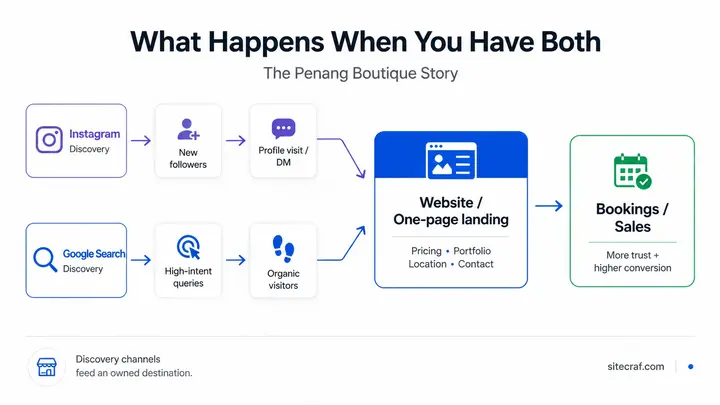
The website didn't replace Instagram. It reached the buyers Instagram couldn't.