Ten years ago, getting your business found online meant one thing: showing up on Google.
That's still important. But it's no longer the whole picture.
Today, a growing number of people skip Google entirely. They type their question into ChatGPT, ask Perplexity for a recommendation, or let Gemini summarise their search results. If your business only appears on Google and nowhere else, you're invisible to every one of those people.
This is why three separate disciplines now exist — SEO, AEO, and GEO — and why small businesses that understand the difference will have a meaningful advantage over those that don't.
Why Three Terms? Because Search Has Splintered
Until recently, "getting found online" meant one channel: the Google search results page. You optimised for Google, you ranked on Google, and that was the job.
Now your customers search in at least three different ways:
- They type a query into Google and click a link in the results
- They ask a question to an AI assistant (ChatGPT, Perplexity, Gemini) and read the answer it generates
- They use an AI-powered search tool that summarises information from multiple sources and gives a direct recommendation
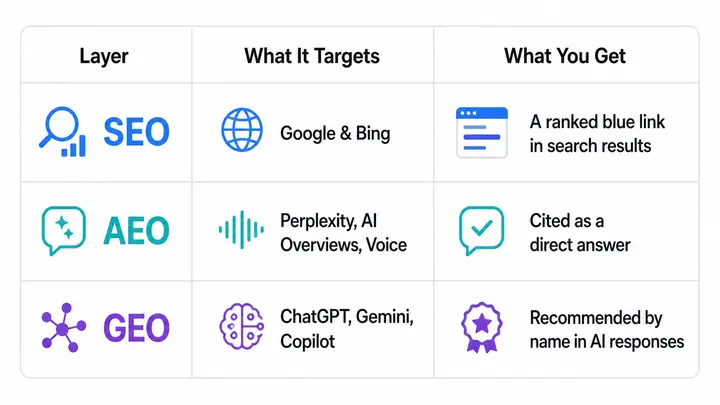
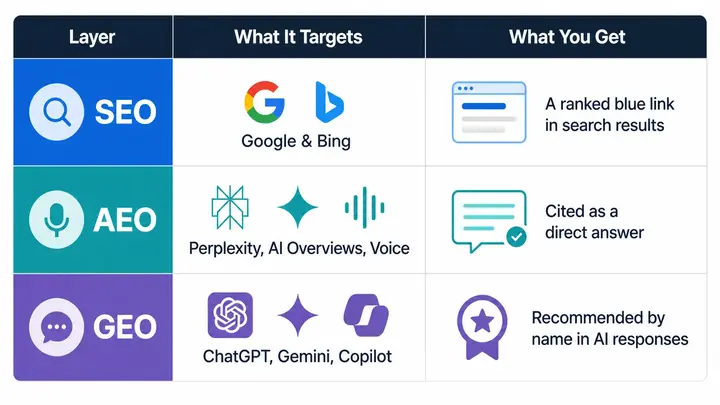
Each of these requires a different approach. SEO handles the first. AEO handles the second. GEO handles the third.
What Is SEO (Search Engine Optimization)?
SEO is the practice of making your website appear in Google search results when people search for what you offer.
When someone in Kuala Lumpur types "best accounting firm for small business" into Google, the firms that appear at the top didn't get there by accident. Their websites were built and maintained to signal to Google: this site is relevant, trustworthy, and worth showing.
SEO involves:
- Using the right keywords in your page titles, headings, and content
- Building a fast, mobile-friendly website
- Earning links from other credible websites
- Creating content that matches what your customers are searching for
- Maintaining a Google Business Profile for local searches
SEO is foundational. Without it, your website is a brochure that nobody receives.
What Is AEO (Answer Engine Optimization)?
When someone asks ChatGPT "what should I look for in a web design agency in Malaysia?" — ChatGPT doesn't search Google. It generates an answer based on what it has learned from across the web. If your website contains clear, well-structured answers to the questions your customers are asking, there's a higher chance that AI assistants cite your content or reflect your expertise in their responses.
AEO involves:
- Writing content that answers specific questions directly and clearly
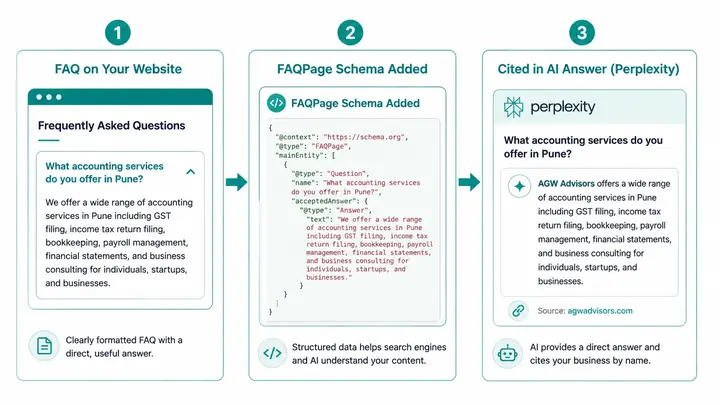
- Using FAQ sections with natural question-and-answer formatting
- Structuring pages with clear headings so AI tools can parse them easily
- Keeping definitions concise and positioned early in each section
- Avoiding buried answers — state the point first, then explain
Think of AEO as writing for a very well-read assistant who reads your page in two seconds and decides whether it's worth quoting.
What Is GEO (Generative Engine Optimization)?
GEO is making your business understood, trusted, and recommendable by large language models (LLMs) — the AI systems behind ChatGPT, Perplexity, Gemini, and similar tools.
AEO and GEO overlap, but GEO goes further. It's not just about whether your content answers a question — it's about whether AI systems have enough structured, consistent, and credible information about your business to confidently name and recommend you.
If someone asks ChatGPT "can you recommend a web agency in Malaysia that handles SEO and website care?", GEO is the work that determines whether Sitecraf appears in that answer — or doesn't.
GEO involves:
- Being mentioned and linked to on credible third-party websites
- Having consistent business information across your site, directories, and social profiles
- Using structured data (schema markup) so AI systems can identify your business type, location, and services
- Publishing authoritative content that AI models learn from over time
- Building a content footprint broad enough that LLMs encounter your business across multiple sources
GEO is a longer game than SEO. But it's the game that determines whether your business exists in the AI-powered version of search.
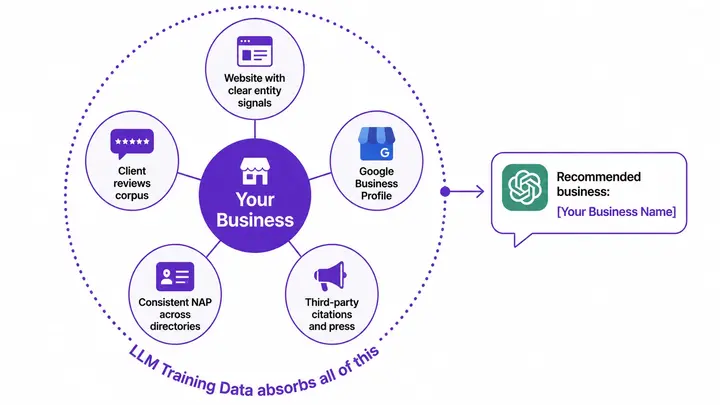
SEO vs. AEO vs. GEO: How They're Different
| | SEO | AEO | GEO | |---|---|---|---| | Goal | Rank in Google search results | Get quoted by AI assistants | Get recommended by AI systems | | Platform | Google, Bing | ChatGPT, Perplexity, Gemini | All LLM-powered tools | | Key technique | Keywords, backlinks, site speed | Direct answers, FAQ structure, clear headings | Structured data, third-party mentions, content authority | | Timeline | 3–6 months to see results | Ongoing, but faster to implement | Long-term brand authority building | | Can you measure it? | Yes — Google Search Console | Partially — manual spot checks | Partially — brand mention tracking | | Small business priority | High — start here | Medium — build alongside SEO | Medium — grows with content volume |
Do Small Businesses Actually Need All Three?
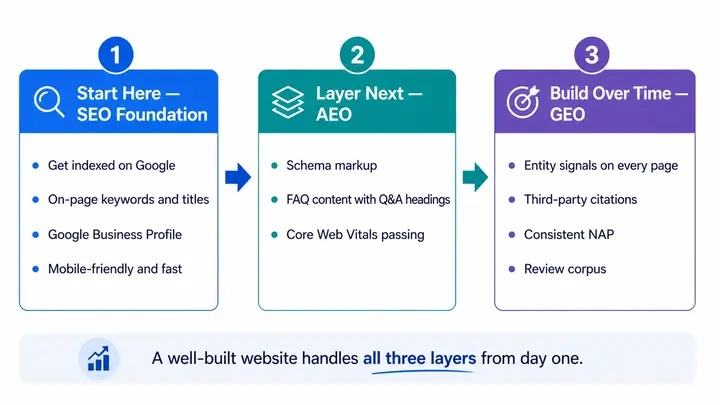
Yes — but not all at once, and not at the same level.
Start with SEO. Without it, your website has no foundation. Google is still how the majority of local searches end in a business contact. If you're not ranking, you're not visible to your core customer base.
Add AEO as you build content. Every blog post, FAQ section, and service page you write should be structured for answer engines. This doesn't require extra work — it requires a different way of writing. Write answers before explanations. Use headings that state the point. Keep definitions tight.
Build toward GEO over time. GEO is less about individual actions and more about cumulative presence. The more credible content you publish, the more third parties reference you, and the more consistent your business information is across the web — the stronger your GEO signal.
A small business in Kuala Lumpur or Bangalore that handles all three is visible in Google search, surfaced by AI assistants, and recommended by AI tools — three separate audiences, one coherent strategy.
How to Start: The Practical Priority Order
- Build a fast, mobile-friendly website with proper SEO foundations (titles, headings, meta descriptions, Google Business Profile)
- Write content that answers real customer questions — service pages, FAQ sections, blog posts structured for AEO
- Be consistent everywhere — same business name, address, and phone number across your website, Google Business Profile, and any directories
- Publish regularly — even one well-structured article per month compounds into a strong GEO signal over 12 months
- Earn mentions — get listed in local directories, ask clients for reviews, seek links from industry sites
None of this requires a large budget. It requires a website built correctly from the start and a content plan you actually follow.