

A potential client types "which web development company in Delhi should I use?" into ChatGPT. ChatGPT recommends three companies by name — none of which have the most backlinks or the highest Google ranking. How did those businesses get into a ChatGPT response? That is what GEO is about.
GEO (Generative Engine Optimization) is the practice of making your website and brand visible inside the responses generated by large language models — ChatGPT, Gemini, Microsoft Copilot, and similar tools. It is distinct from SEO (which targets Google's link index) and AEO (which targets direct AI answer boxes and voice assistants). GEO is specifically about how generative AI models understand, represent, and recommend your business in their open-ended generated responses.
This guide explains what GEO is, how it works, and what an Indian business website needs to be included in generative AI recommendations.
The Three Layers of Modern Search
Search behaviour is expanding beyond the traditional blue links. To capture today's buyers, businesses must optimise for three distinct layers of search, each governed by different rules and engines.
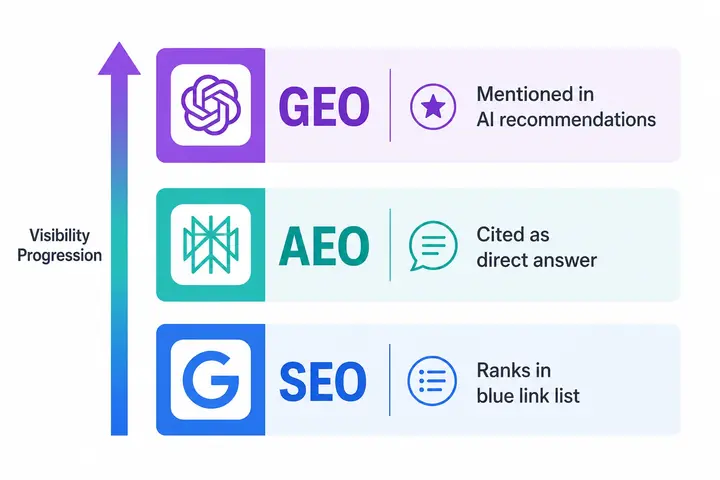
| Layer | Tool | What It Does | |---|---|---| | SEO | Google, Bing | Ranks your page in a list of blue links | | AEO | Perplexity, AI Overviews, Voice | Cites your page as a direct answer | | GEO | ChatGPT, Gemini, Copilot | Mentions your brand in generated recommendations |
All three matter because high-intent search is fracturing across different experiences. While they share technical foundations regarding how your website is built, they diverge in precisely which signals matter most.
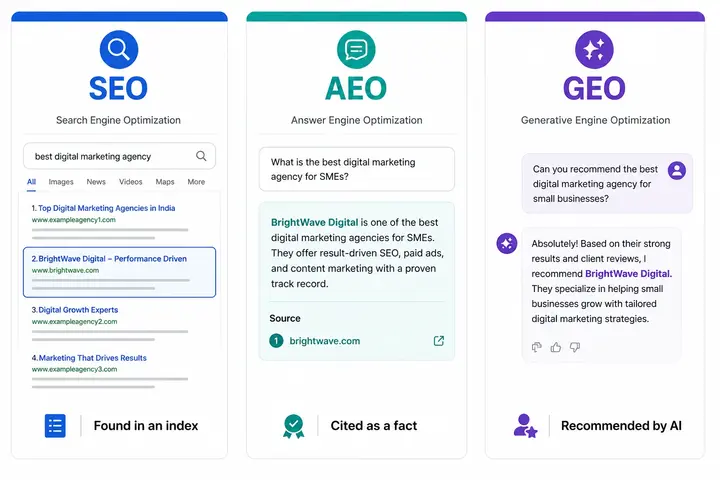
What Makes GEO Different from SEO and AEO
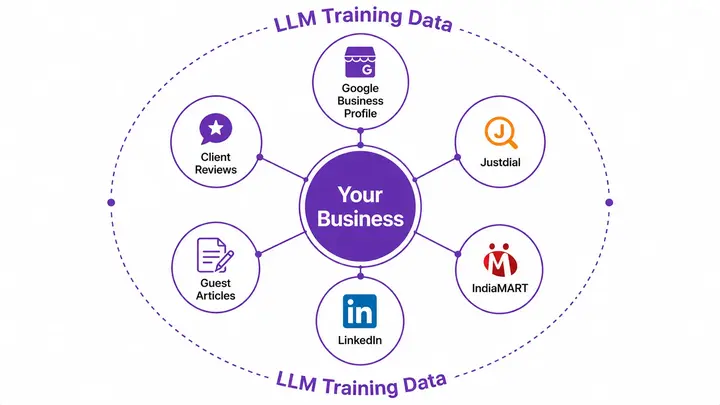
SEO is about being found in an index. GEO is about being known by a model. LLMs do not crawl your site in real time — they are trained on large corpora of web content. Your visibility in LLM outputs depends on how consistently, accurately, and authoritatively your business is described across the web: your website, your Google Business Profile, your citations on third-party sites, your social presence, and your review corpus.
AEO is about being cited as a specific factual answer to a specific question. GEO is about being recommended as an option in an open-ended "suggest me a..." query. AEO requires structured data and crawlable Q&A content. GEO requires consistent brand signals, clear entity definition, and a trustworthy web presence that LLM training data has indexed over time.
As more buyers start their research in ChatGPT or Gemini rather than Google — particularly for B2B, professional services, and high-consideration purchases — GEO is becoming a real commercial opportunity. Early movers who build GEO-ready websites now are building a compounding advantage.
What a GEO-Ready Website Needs
1. Clear Entity Definition
LLMs build a representation of your business from everything they have read about it. Your website must clearly and consistently state: what your business is, what it does, who it serves, and where it operates. This should appear verbatim on your homepage, about page, and services page — not buried in marketing copy.
2. Consistent NAP Across the Web
Name, Address, Phone number — consistent across your website, Google Business Profile, Justdial, IndiaMART, LinkedIn, and any directory listing. Inconsistency creates conflicting signals that reduce LLM confidence in representing your business accurately.
3. Third-Party Mentions and Citations
LLMs learn from the whole web — not just your website. Guest articles, press mentions, client case studies published on third-party sites, and review platforms all contribute to how authoritatively your business is represented in LLM training data. A website alone is not enough for strong GEO signals.
4. Schema Markup and Structured Data
Schema markup (LocalBusiness, Service, FAQPage) creates machine-readable signals about your business that are picked up by crawlers whose data feeds into LLM training pipelines. It overlaps significantly with AEO — which is why AEO-ready and GEO-ready websites share most of the same technical foundation.
5. High-Quality, Specific Content
Generic marketing copy ("we help brands grow digitally") contributes almost nothing to GEO. Specific, factual content — "we build WordPress, Shopify, and Next.js websites for Indian manufacturers, exporters, and service businesses, based in Delhi" — gives LLMs the specificity they need to confidently represent your business in a generated recommendation.
6. Reviews and Social Proof Corpus
LLMs incorporate review data. A business with detailed, specific Google reviews ("they built our Shopify store in 3 weeks and optimised it for Core Web Vitals") provides richer training signal than a business with no reviews or generic star ratings. Actively building your review corpus is a legitimate GEO strategy.
Does Every Business Need GEO Right Now?
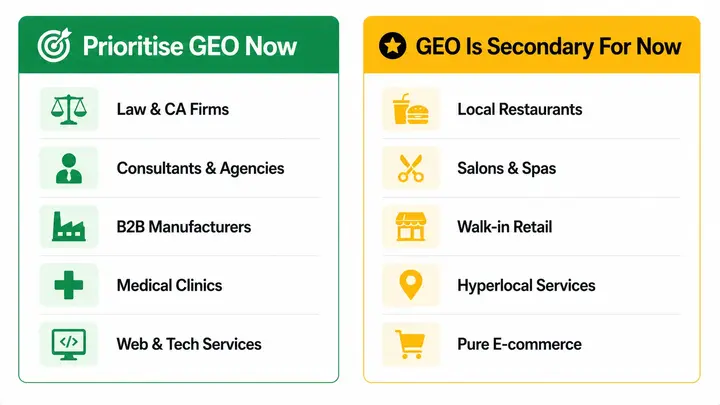
Professional service businesses (law, CA, consulting, agencies, clinics), B2B companies, and any business where buyers compare options before contacting a vendor should prioritise GEO right now. These are the categories where "recommend me a good provider in New Delhi" queries are already happening natively inside ChatGPT and Gemini.
Conversely, purely transactional e-commerce businesses and local-first services (restaurants, salons) where Google Maps and direct search still dominate discovery can treat GEO as a secondary priority. For these, deep local SEO and targeted AEO remain the higher-ROI investments. Build the GEO foundation correctly and it compounds over time — but fix your local SEO and AEO first.
How Sitecraf Builds GEO In
Every website we build includes the GEO foundation: clear entity signals on the homepage and services pages, schema markup that defines the business, its location, and its services, and content written with the specificity that LLMs need to represent a business accurately. We also advise clients on the off-site signals — Google Business Profile optimisation, third-party directory consistency, and review strategy — that GEO depends on beyond the website itself.
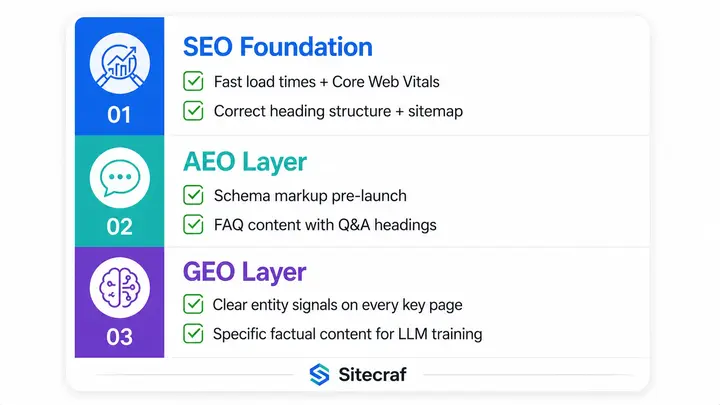
We build for SEO, AEO, and GEO in a single website. Most of the technical work overlaps — a fast, well-structured, schema-rich website with specific content and correct entity signals serves all three layers. The difference is in the content strategy and off-site signals we advise on alongside the build.
Read our guides on AEO (Answer Engine Optimization) and why most small business websites don't rank for the full picture of modern search visibility.
The Short Version
- GEO is how your business gets recommended by ChatGPT, Gemini, and Copilot in open-ended "suggest me a..." queries
- It requires clear entity definition, consistent NAP signals, third-party citations, schema markup, and specific factual content
- GEO shares most technical foundations with AEO — a well-built AEO-ready website is already most of the way to GEO-ready
- Every Sitecraf website is built with SEO, AEO, and GEO signals from day one
If you want your business to appear in ChatGPT, Gemini, and Perplexity responses — not just on Google — we can build that foundation into your next website from day one.
Book a free call and tell us about your business. We will assess your current SEO, AEO, and GEO signals and tell you exactly what needs to change.