

Imagine a potential client, perhaps a business owner like yourself, pulling up ChatGPT or Perplexity and searching for the "best CA firm in Delhi." Within seconds, the AI tool provides a clear, direct answer naming two specific firms. Here is the catch: neither of those firms has the most heavily SEO-optimised website on Google. So, the inevitable question arises: why did those firms appear as the recommended answer, and why was your business entirely absent?
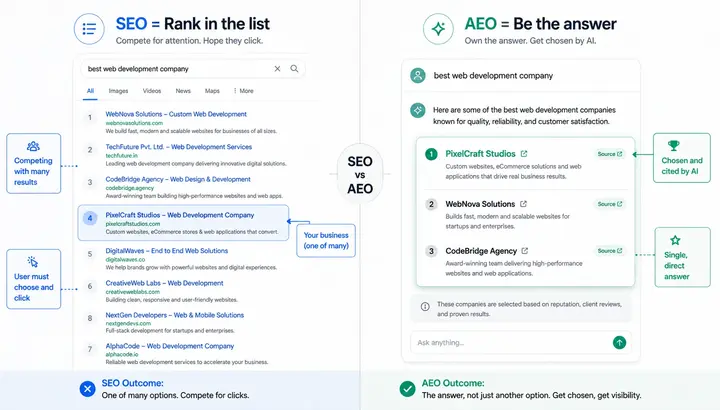
This scenario perfectly illustrates the growing difference between traditional SEO (getting your website found as a blue link on Google's search results) and AEO (getting your business cited as a trusted direct answer by modern AI tools). Both forms of visibility matter immensely today. But most websites are built almost exclusively for the first one, leaving them completely invisible in the rapidly expanding world of AI search.
This guide explains what AEO is, how it differs fundamentally from standard SEO, and what your website actually needs from a technical perspective to be cited by the latest AI tools.
What Is AEO?
Answer Engine Optimization (AEO) is the practice of structuring your website's content, data, and technical setup so that AI tools — including ChatGPT, Perplexity, Google AI Overviews, Bing Copilot, and various voice assistants — can easily read, understand, and cite your business as a trusted, direct answer to a user's question.
The core difference between AEO and SEO comes down to the ultimate end goal. SEO is largely about earning a high ranking in a long list of external links. AEO, on the other hand, is about being the single, definitive answer that effectively replaces that list. Both disciplines share important technical foundations, such as fast page loading, clear site architecture, and high-quality content. However, AEO requires additional, specialised layers of information to be truly effective. This includes implementing schema markup, organizing content in a question-and-answer format, providing clear entity signals (unambiguous details about what your business is, where it operates, and exactly what services it provides), and writing content in a structured way that an AI model can extract and accurately summarise.
To give you a practical example, assume a user asks Perplexity, "which web development company in Delhi offers WordPress and Shopify?" Perplexity does not just look for a page stuffed with keywords or the domain with the highest number of backlinks. Instead, it pulls information from websites that explicitly state those exact facts in a cleanly structured, crawlable, and trustworthy format. AEO is about transforming your website into that crystal-clear, optimally structured source of truth.
Why AEO Matters Right Now
We are currently witnessing a profound shift in search behaviour. A rapidly growing number of people — particularly younger buyers and corporate decision-makers — now begin their product research or vendor evaluation on ChatGPT or Perplexity rather than starting with a traditional Google search. They are no longer looking to scroll through a list of links and piecing together information across ten different tabs. They want a concise, direct answer compiled specifically for them. If your website is not structured in a way that AI tools can seamlessly parse and trust, your business simply does not exist in this new critical layer of search visibility.
For Indian businesses specifically, this shift brings massive new opportunities. Voice search in Hindi, Hinglish, and regional languages is growing exceptionally fast. When someone uses a voice assistant, they are given a single spoken citation — there is no "page two" to scroll down. AEO gives Indian businesses a real, immediate opportunity to become that primary citation, allowing progressive small businesses to step ahead of much larger, slower competitors who have not yet adapted their web infrastructure for answer engines.
It is important to offer an honest qualification here: AEO does not replace SEO — it simply extends it. A website that is already technically sound, fast-loading, and rich in good content is significantly closer to being AEO-ready than its owner might think. The additional layer required for AI visibility is mostly about sharpening the structure and specificity of your existing data, rather than throwing everything out and rebuilding continuously from scratch.
What Makes a Website AEO-Ready?
There is no single magic AEO checklist that perfectly applies to every business model — but these are the fundamental technical and content building blocks that every AEO-ready website should have securely in place.
1. Schema Markup (Structured Data)
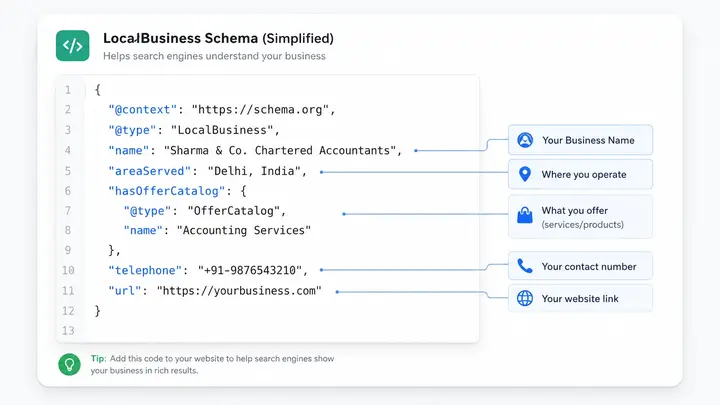
Schema is invisible code added directly to your website's backend that tells search engines and AI tools exactly what your business is in a language they natively understand. It defines critical data points: your exact business name, physical address, service area, the specific services you offer, your verified reviews, and your frequently asked questions. It completely removes ambiguity. An AI tool no longer has to guess what your business does by attempting to interpret a wall of flowery marketing copy. The most important schema types for small and medium businesses generally include LocalBusiness, FAQPage, Service, and BreadcrumbList.
2. Question-and-Answer Content
Fundamentally, AI tools are explicitly designed to answer questions. Websites that organise their content directly around questions — especially the exact phrasing of the questions your customers are actually asking — are far more likely to be cited by an answer engine. A dedicated FAQ section featuring clear question headings followed by direct, one-paragraph answers is one of the most effective and powerful AEO signals a small business website can deploy.
3. Clear Entity Signals
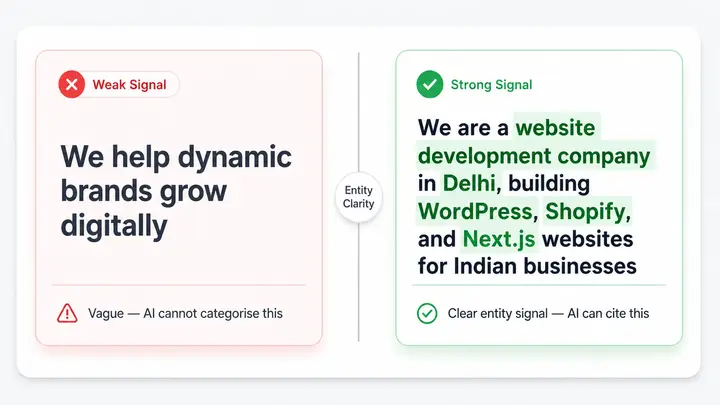
Your website needs to unambiguously state its core identity to machines. It must confidently declare: what your business is, exactly what it does, who it serves, and geographically where it operates. A statement like "We are a website development company based in Delhi, building WordPress, Shopify, Wix, and custom Next.js websites for Indian businesses" is a perfect, clear entity signal. Vague, conceptual copy such as "we help dynamic brands grow digitally" holds almost zero value for an AI trying to categorize your capabilities.
4. Fast Load Times and Core Web Vitals
AI crawlers, much like Google's traditional crawler, heavily favour fast, responsive websites. A slow website is far less likely to be fully indexed, meaningfully analysed, and subsequently cited. Core Web Vitals — metrics like LCP (Largest Contentful Paint), INP (Interaction to Next Paint), and CLS (Cumulative Layout Shift) — are the strictly measurable benchmarks here. A properly built, modern website should load its main content in under 2 seconds, even on a standard mobile data connection.
5. Trustworthy, Accurate Content
AI tools explicitly prefer to pull from sources that demonstrate high authority and trust. This means content that is highly specific, factually accurate, and above all, consistent across the digital web. If your website clearly states you are headquartered in Delhi, but your Google Business Profile says Mumbai, that inconsistency immediately reduces your trust signals in the eyes of an AI. Keeping your NAP (Name, Address, Phone number) details completely consistent across all your digital platforms is a mandatory foundational step.
6. Crawlable, Logical Page Structure
Answer engines heavily rely on structure to understand context. Clean HTML headings (flowing logically from H1 to H2 to H3 in strict order), descriptive page titles, meta descriptions that accurately match the surrounding page content, and a clear, updated XML sitemap all make it exponentially easier for AI crawlers to understand and index your site correctly. Simply put, a page that is messy and structurally hard to parse for a crawler is almost impossible for an AI tool to confidently cite.
Does Every Business Need AEO?
Determining if AEO should be a priority depends heavily on the nature of your business and your current digital maturity.
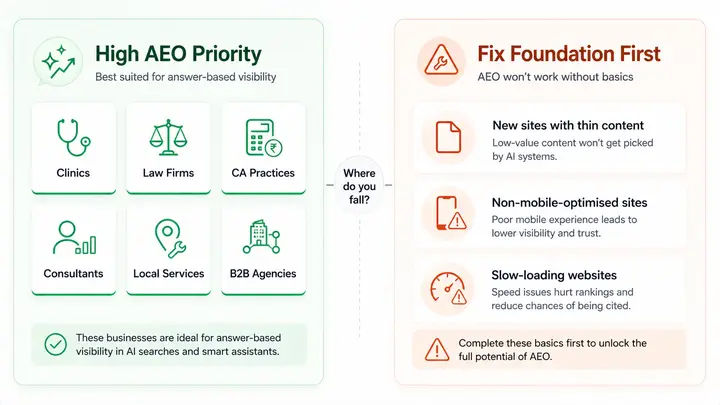
Businesses that rely heavily on local discovery — such as clinics, law firms, CA practices, local service businesses, consultants, and niche specialty agencies — benefit enormously from AEO. This is because AI tools increasingly answer localized queries like "best corporate law firm in Noida" with direct, single-answer citations. E-commerce brands, specialist exporters, and B2B businesses also benefit immensely from AEO, particularly for complex category research and deep product comparison queries.
On the other hand, if your current website is not yet properly built, fails to be fully mobile-optimised, or has virtually no content beyond a thin landing page — you need to fix those fundamental things first. AEO essentially layers on top of a highly solid technical foundation. It does not substitute for one. A well-built, technically sound SEO-ready website is 70–80% of the way to being completely AEO-ready already.
How Sitecraf Builds AEO Into Every Website
At Sitecraf, we do not view AEO as an optional, expensive add-on. Every website we build — whether we are developing on WordPress, setting up Shopify, crafting Wix Studio experiences, or engineering custom Next.js platforms — is delivered with AEO-ready structure meticulously built in from day one. That means custom schema markup is added prior to launch, FAQ content is logically structured with the exact correct heading hierarchy, foundational entity signals are clearly written into your homepage and services copy, and Core Web Vitals are optimized as an integral part of the build — never treated as a final afterthought.
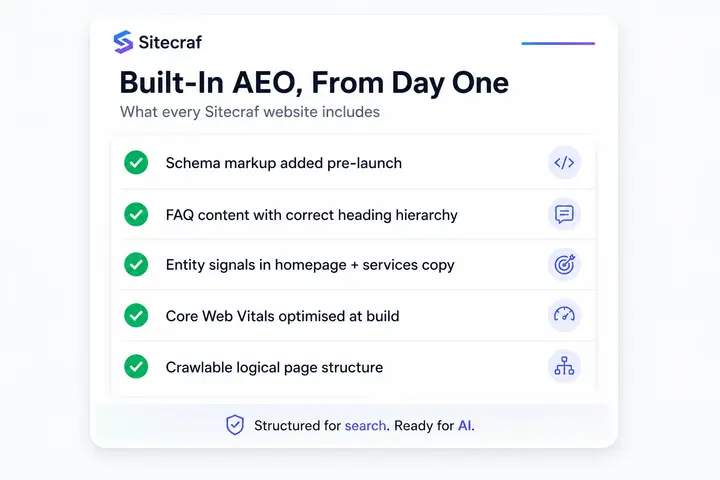
This approach matters immensely for Indian businesses. Most website development services in India still build websites that are optimised solely for traditional Google page-one rankings — a practice which is highly valuable, but increasingly incomplete on its own. We critically build for both layers: the established traditional SEO landscape and the rapidly emerging answer engine layer. A business that significantly invests in a well-built website today, complete with proper AEO structure, is exponentially better positioned as AI-driven search explodes, compared to one that passively waits to "see how it develops."
Before rushing into advanced optimizations, it helps to intimately understand the baseline. You can read more about why most small business websites don't rank to see the technical gaps we fix to ensure a reliably solid foundation.
The Short Version
- AEO is how you make your website visible to AI tools, not just Google blue links
- It requires schema markup, Q&A content, clear entity signals, fast load times, and trustworthy copy
- It layers on top of SEO — a good SEO foundation is already most of the way there
- Every website Sitecraf builds includes AEO-ready structure from day one
If you are unsure whether your current website is truly AEO-ready — or if you are deliberately planning a new build and want AEO properly built in from the very start — we are happy to take a close look and give you an honest, transparent assessment.
Feel free to book a free call and tell us about your business. We will tell you exactly what your website needs — and more importantly, what it does not.