"Should we build on WordPress or go custom with Next.js?" is one of the most common questions we get from Indian businesses planning a new website. Both are legitimate choices. Both can rank well. But they serve very different kinds of businesses — and choosing the wrong one creates problems that compound over time.
This is not a technical deep-dive. It is a practical guide for business owners who need to make a real decision — with a clear recommendation at the end based on what your business actually needs.
The short answer: WordPress wins for most content-driven businesses. Next.js wins when performance, custom functionality, or AEO-first structure is the priority. The longer answer follows.
What Each Platform Actually Is
WordPress powers over 40% of all websites on the internet. It is a content management system (CMS) built around ease of content publishing, a massive plugin ecosystem (including Yoast SEO and Rank Math for on-page SEO), and a large global community of developers and designers. A well-configured WordPress site with a lightweight theme and good hosting can rank extremely well.
Next.js is a React-based framework used to build custom websites and web applications from scratch. There are no default plugins or page builders — everything is coded. That means more control over performance, structure, and functionality — but also more build time and a more technical team required to maintain it. Sites like Notion, Vercel, and many modern SaaS products are built on Next.js.
SEO: Where They Are Equal
Both platforms can achieve excellent search rankings when properly built. Google does not penalise or favour either platform inherently. The fundamentals that drive SEO — content quality, page speed, mobile responsiveness, backlinks, schema markup, and correct heading structure — are achievable on both WordPress and Next.js. The reality of WordPress vs Next.js SEO is that standard ranking signals can be satisfied efficiently by either choice.
The honest caveat: The difference is not which platform can rank — it is which platform makes it easier to maintain ranking signals over time, and which is better suited to your team's capability and your content volume.
Where They Differ: The Real Trade-offs
Page Speed and Core Web Vitals
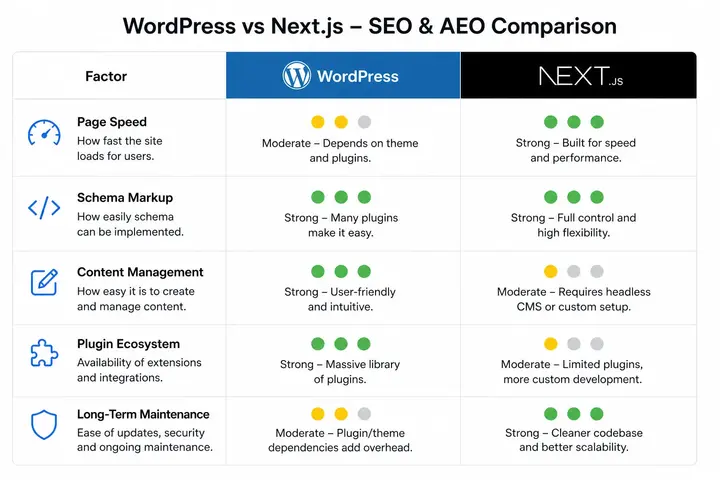
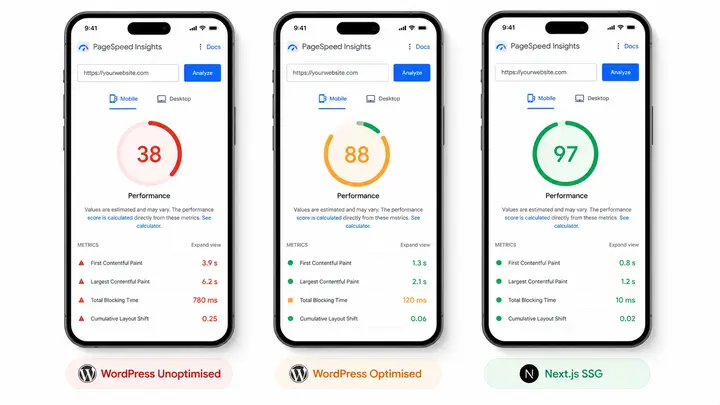
Next.js has a natural speed advantage — it generates static HTML pages at build time (SSG), which load faster than WordPress pages rendered server-side on each request. A poorly configured WordPress site with heavy plugins and shared hosting will fail Core Web Vitals. A properly configured WordPress site on good hosting with a lightweight theme will pass them. Next.js makes it easier to hit the top tier of performance without plugin-level compromise.
Schema Markup and AEO Readiness
Both platforms support schema markup — but Next.js gives developers precise control over exactly what schema is added to every page, without relying on plugins that may add redundant or conflicting markup. For businesses prioritising AEO (Answer Engine Optimization), custom Next.js offers cleaner schema implementation out of the box to deliver a truly AEO ready website. WordPress achieves the same results with Yoast or Rank Math, but requires more careful configuration.
Content Management and Publishing
WordPress wins decisively here. Its editor (Gutenberg or Classic) is built for non-technical teams to publish and update content without developer involvement. A marketing team can update a WordPress site daily without touching a line of code. Next.js has no built-in CMS — content is managed through a headless CMS (like Contentful, Sanity, or Keystatic) which adds complexity and cost. For businesses publishing regular blog content, product updates, or news — WordPress is the practical choice.
Plugin Ecosystem vs Custom Functionality
WordPress has a plugin for almost everything — contact forms, booking systems, membership areas, WooCommerce for e-commerce, multilingual support, advanced SEO tooling. This is a genuine strength for most businesses. The risk is plugin bloat: too many poorly maintained plugins slow the site and create security vulnerabilities. Next.js has no plugin ecosystem — every feature is custom-built. This is more expensive upfront but produces a cleaner, faster, more secure result for complex requirements.
Long-Term Maintenance
WordPress requires ongoing maintenance: security updates, plugin updates, hosting management, occasional compatibility fixes as plugins update. Without active management, a WordPress site degrades over time. Next.js sites (especially statically deployed on Vercel or Netlify) have significantly lower maintenance overhead — fewer moving parts means fewer things to break. For small teams without a dedicated developer, this matters.
The SEO Verdict: When to Choose Each
Choose WordPress if:
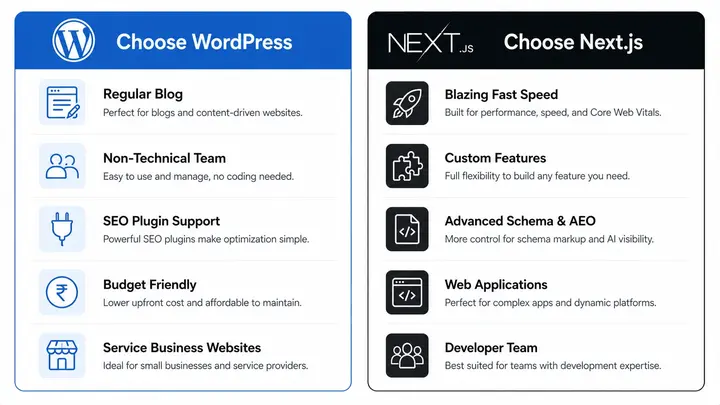
- You need to publish content regularly (blog, news, product updates)
- Your team will manage the site without a developer
- You want proven SEO plugins (Yoast, Rank Math) with minimal setup
- Your budget is ₹12,000–₹35,000 and you need a fast, proven delivery
- You run a service business, portfolio site, or content-driven brand
Choose Next.js if:
- Performance is a non-negotiable priority (Core Web Vitals, sub-2-second load times)
- You need custom features that no WordPress plugin provides out of the box
- You want full AEO-ready schema control without plugin dependency
- Your site doubles as a web application (portals, dashboards, custom tools)
- You have a developer or development partner who can maintain a codebase
What About Shopify and Wix Studio?
This comparison focuses on WordPress vs Next.js because those are the two platforms most businesses debate when SEO is the priority. If you are building an online store, Shopify is likely the better starting point than either. If you want a fast, visually editable business website at a lower budget, Wix Studio is worth considering. We covered the full platform breakdown in our website development services section.
What Sitecraf Recommends
For most Indian small and medium businesses — service companies, exporters, B2B brands, local businesses — WordPress is the right starting point. It is proven, well-supported, easier to maintain independently, and when built correctly it performs as well as any custom site for standard SEO requirements. If you consult an experienced website developer Delhi or anywhere else across the country, a fast WordPress build often hits the strategic sweet spot for marketing focus over sheer engineering complexity.
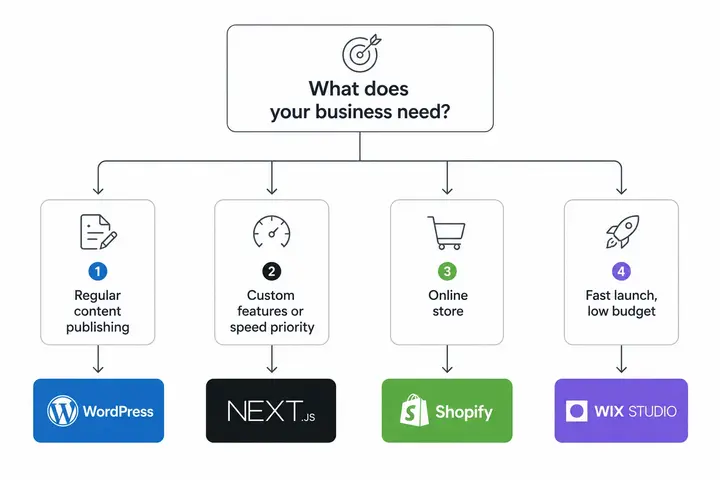
We recommend Next.js when a client genuinely needs what it delivers: sub-second load times, complex custom functionality, or a website that will evolve into a web application through custom website development India. We do not recommend it simply because it is technically impressive — the build cost and maintenance model need to match the business's actual needs and team capability.
The biggest SEO mistakes we see are not platform choices — they are build quality issues that happen on any platform. Missing schema markup, poor mobile performance, no structured content hierarchy, thin copy. If you want to understand why most websites don't rank after going live, that article covers the common gaps in detail.
The Short Version
- WordPress is better for content-driven businesses, non-technical teams, and budgets under ₹35,000
- Next.js is better for performance-critical builds, custom functionality, and AEO-first schema control
- Both can rank well — the difference is in build quality, hosting, and ongoing maintenance
- Most Indian SMBs are better served by a well-built WordPress site than a poorly maintained Next.js build
Not sure which platform is right for your business? We work across both — and across Shopify and Wix Studio — so our recommendation is based on your goals, not on which platform we prefer to build.
Book a free consultation and tell us what your website needs to do. We will recommend the right platform and give you a fixed quote before any work begins.